 Remington Croft
How to Check Tire Tread Depth at Home in 2026 (Penny, Quarter, Gauge)
Last updated: September 12, 2026 — rechecked penny and quarter thresholds and wear-bar logic against maker guides and refreshed wet-weather replacement advice.
Reviewed by Emily Holmes, General Reviewer, following our test method.
How to check tire tread takes 60 seconds per tire: push a penny head-down into three grooves, read the wear bars, and confirm low spots with a gauge. Replace at 2/32 inch legally, plan shopping at 4/32 for wet grip.
Quick answer: penny test is best for a fast pass-fail at 2/32. Quarter test plus wear bars is best for wet-weather planning at 4/32. Probe gauge on inner, center, and outer grooves is best for an exact number. Details below — you'll need a penny.
Quick Comparison: Tire Tread Checks at a Glance
Start free with coins, confirm with a gauge only where coins look close. Check all four tires because fronts often wear faster — that's where your steering lives.
| Method | Key Points | Best For |
|---|---|---|
| Penny test | US penny, Lincoln head down, three grooves per tire, 2/32 pass-fail | Best overall fast check |
| Quarter plus wear bars | US quarter to Washington head, raised bars at 2/32, 4/32 wet planning | Best value wet-weather call |
| Probe depth gauge | Graduated probe in 32nds and mm, base flush on ribs, lowest reading wins | Best exact number |
Dive deeper: Tire Tread Depth Chart Explained; How to Use A Tread Depth Gauge; How to Do The Penny Test Correctly.
Check penny head-down for the 2/32 limit and multiple spots per tire per Bridgestone. Treat 10/32 as new, 6/32 as still good, 4/32 as the wet-replacement threshold, and 2/32 as urgent per Pirelli. Recheck every 3,000 miles with penny, quarter, gauge, or wear indicator per Goodyear.
What the Numbers Mean Before You Kneel Down
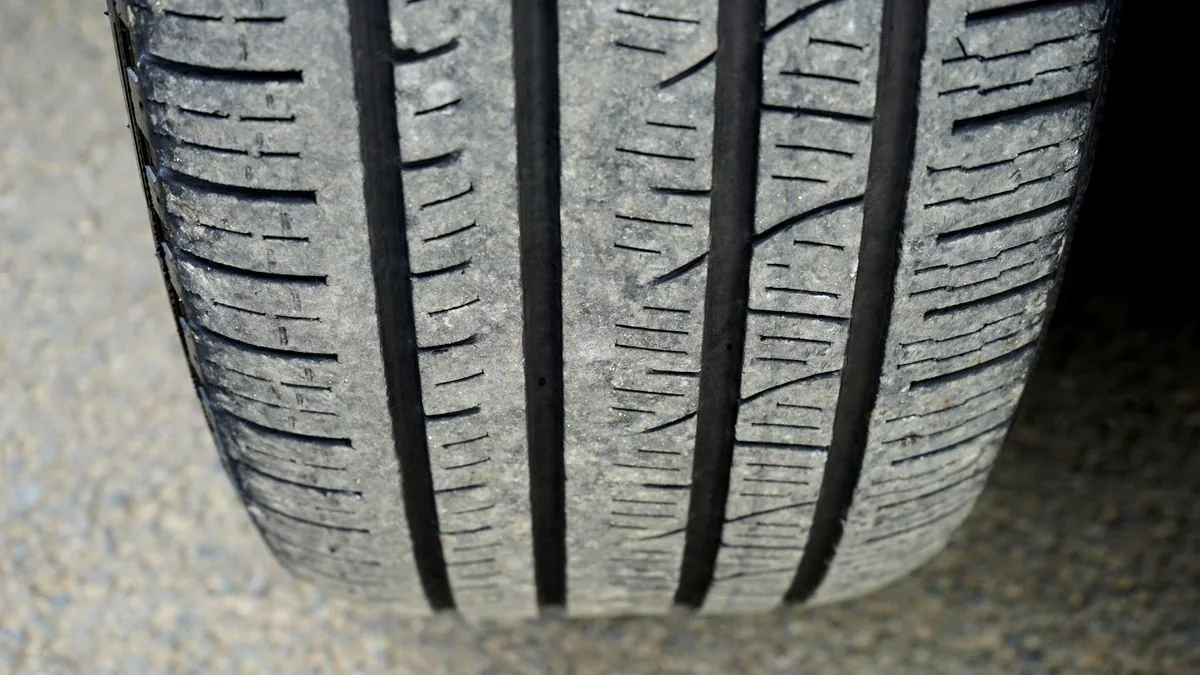
Worn tread up close — if yours looks like this, keep reading. (Illustrative stock photo via Pexels.)
US tread is measured in 32nds of an inch. New all-season tires start around 10/32 to 11/32, with some truck, SUV, and winter tires deeper. At 6/32 most experts still call grip good. At 4/32, wet braking and hydroplaning resistance fall off enough that shops advise shopping now. At 2/32 the US Department of Transportation says replace — and many states make it law. Winter drivers should think even earlier, because snow bite fades well above the legal minimum.
- 10/32 to 11/32: new tire depth. Baseline for comparing your readings.
- 6/32: still good for most dry and light rain driving.
- 4/32: plan replacement if you drive rain, highways, or with kids aboard.
- 2/32: replace now. Any single groove at this depth fails the whole tire.
- Start with coins when: you want a driveway answer today with no tools.
- Bring out the gauge when: coins look borderline or you track wear across rotations.
- Spec to confirm: inner, center, and outer grooves separately. One low groove fails the tire even if the others pass.
Method 1: Penny Test for the 2/32 Limit
Park on flat ground, set the brake, and pick the tire that looks most worn first. Hold a penny with Lincoln head-down facing you and push it into a main groove between raised ribs — not onto a wear bar or shoulder. Crouch so your eyes are level with the tread. If tread covers any part of Lincoln's head, that groove is still above 2/32. If you see all of his head with space above it, or the tread sits flush with the top of his head, that spot has reached the limit. Repeat in at least three spots around the tire plus inner, center, and outer grooves, then repeat on all four — including the spare-side rears everyone skips.
- Grab a penny when: you need a legal pass-fail answer with pocket change.
- Fail rule: any single spot that shows full Lincoln head fails the tire. Deeper grooves elsewhere do not save it.
- Mistake to avoid: testing only the easy outer edge. Inner edges hide the worst wear on misaligned cars.
Method 2: Quarter Test and Wear Bars for Wet Planning
The quarter test catches trouble earlier than the penny. Push a quarter head-down into the groove with Washington facing you. If tread touches his head, you still hold about 4/32 — the point to start shopping if rain matters in your climate. Then find the raised wear bars molded across the grooves at 2/32. Sight along the groove: if tread sits flush with any bar, replacement is due even if neighboring grooves look deeper. Bars hide at several points around the tire, so roll forward slightly to expose the sections you can't see.
Video: How to Check Your Tire Tread at Home — Bob Ruth Ford, May 2026.
- Think quarter when: your penny passes but wet braking feels long or puddles tug the wheel.
- Skip guessing if: bars are hard to see through dark grooves. Run a fingertip across; a flush bar feels like a speed bump that matches the ribs.
Method 3: Probe Gauge for the Exact Reading
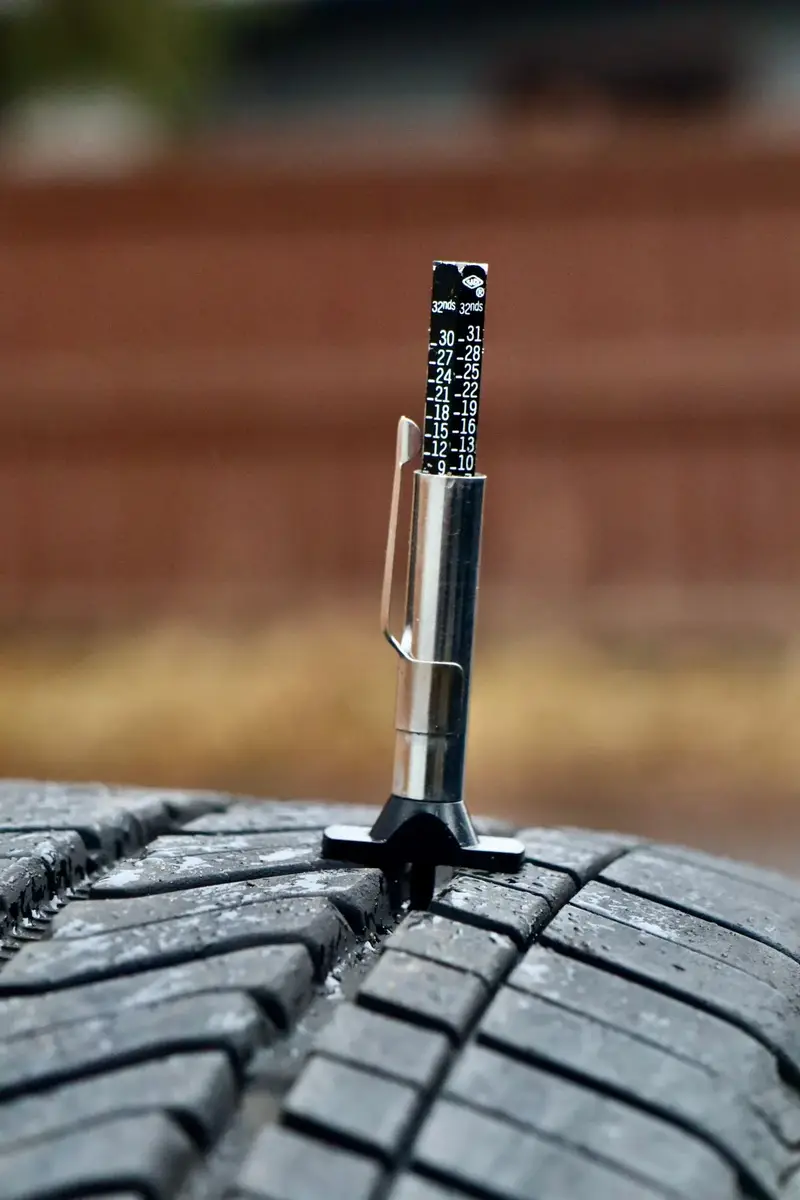
Gauge seated in the groove — base flat on the ribs, that's the whole technique. (Illustrative stock photo via Pexels.)
Extend the probe fully, drop it into the lowest-looking groove, and press the gauge base flat across the two neighboring ribs. Read where the shaft stops in 32nds and millimeters — digital gauges show it on screen, probe styles on the slider. Log inner, center, and outer on each tire and keep the lowest as the tire's score. A spread across one tire tells a story: center-only wear points to overinflation, both edges to underinflation, one-sided feathering to alignment, and cupped scallops to balance or suspension that wants a shop visit rather than more air.
- Go gauge when: you rotate tires yourself, track miles, or need proof for a warranty claim.
- Technique: base must sit on ribs, not tilt into the groove, or readings run falsely deep.
Uneven Wear: What the Pattern Tells You
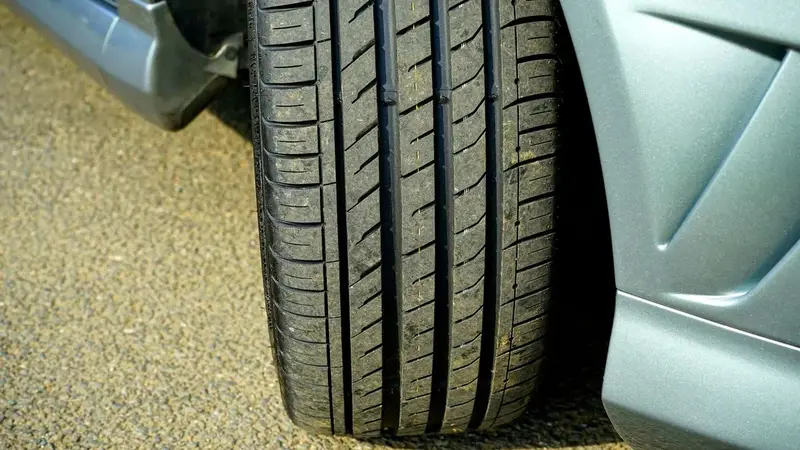
Reading the wear like a palm: edges, center, and cups each confess something. (Illustrative stock photo via Pexels.)
Even wear around the whole tire is normal — it just means miles. Anything else deserves a cause check before you buy the same wear again. Center rib bald while edges look fine usually means chronic overinflation ballooning the middle. Both shoulders worn with a high center usually means underinflation folding the edges down. One shoulder or feathered blocks across the tread usually mean toe or camber alignment is off. Patchy cups or scallops usually mean balance, worn shocks, or loose parts bouncing the tire. Cuts, bulges, sidewall cracks, or cord showing mean stop driving on that tire regardless of groove depth. Don't negotiate with those.
What to Do When a Tire Fails
- Don't wait for all four: replace in axle pairs at minimum so braking stays balanced left to right.
- Check age too: read the DOT date code on the sidewall. Old rubber with legal tread still hardens and cracks — tread isn't the whole story.
- Air and spare: set pressures to the door-jamb sticker, not the sidewall max, and check the spare groove while you're dirty.
- Shop note: bring your lowest readings per tire and where they sat. That sentence saves a diagnostic fee.
Setup Tips for a 5-Minute Monthly Routine
Check monthly and before long trips — always cold, before driving heats the air. Keep a penny and a probe gauge in the glove box with a flashlight, because garage shadows hide wear bars. Chalk-mark the lowest groove so the shop sees the same spot you saw. Photograph each tire with the coin in place for your records. Pair the tread check with pressure, sidewall scan, and lug visual so one kneel-down covers the whole wheel. Rotate on the manual schedule so front-drive chew evens out. Five minutes in the driveway beats an afternoon on the shoulder.
Tire Tread FAQ
How often should I check tire tread?
Check monthly and before road trips, plus after pothole season. Makers suggest a depth look about every 3,000 miles because wear accelerates once grooves shallow and wet stopping stretches.
Is the penny test accurate?
Yes as a 2/32 pass-fail because the distance from coin edge to Lincoln head top matches that depth. It does not tell 4/32 or 6/32, so follow a pass with the quarter test if rain performance matters.
What is the difference between 2/32 and 4/32?
2/32 is the legal replacement floor in the US. 4/32 is the practical wet-grip shopping point where stopping distances grow. Replace at 2/32 always, shop at 4/32 if you drive wet highways.
Can I drive briefly on a tire that fails the penny test?
Drive only to the shop — slowly, avoiding rain and highways. A failed groove can't clear water, so hydroplaning risk jumps. Put your best tires on the rear for stability on the way in.
Do winter tires need deeper tread?
Yes. Winter bite fades well above 2/32, so many shops advise 6/32 as the winter service limit. If snow is your season, treat 4/32 all-season readings as the end of winter duty.
Bottom Line
Penny-test grooves above 2/32 pass, quarters or wear bars at 4/32 mean shop for wet grip, and a probe gauge on inner, center, and outer grooves confirms the lowest reading wins across all four tires.
Related Guides
- Tire Tread Depth Chart Explained
- How To Use A Tread Depth Gauge
- How To Do The Penny Test Correctly
- Uneven Tire Wear Causes And Fixes
- Tire Tread Cracking Troubleshooting
- Summer Vs All Season Tread Patterns
- How To Know When To Replace Tires
- Tire Replacement And Rotation Cost
- How to Measure Inseam for Perfect Pants Length in 2026
- How to Snowboard for Beginners in 2026
- 4 Best Leather Laptop Bags for Work in 2026
- How to Measure a Room for Furniture in 2026 (Sketch, Clearance, Delivery)
Sources: Bridgestone — Penny Test; Pirelli — Tire Tread Depth; Goodyear — How to Measure Tread Depth; YouTube — Penny Test Explained; Photos: Pexels 116676, 20303832, 37091334.